
In the ‘80s, it was all ball bearings. Now, it’s all scams.
I think most of us are pretty familiar with the various gambits these days: the bogus PayPal invoice, the U.S. Postal Service failed delivery notice, and the “I hacked your computer and will release video of you watching deviant porn” ruse.
Recently, I discovered a new universe of cons—the literary scam. It’s a niche one, but it’s a thing.
Since my new book dropped a couple of weeks ago, I have been receiving a flood of messages from people trying to sell me their services: boosting my Amazon ratings or creating dramatic video trailers of my book—pretty sure I can have AI do that one for me at this point.
I have no idea how many of those offers are “legitimate” services where the provider would actually take my money and do something versus scams where they will just take my money. Either way, there is nothing at all tempting about those proffers.
However, I recently received an email that made me pause for a few seconds.
I was out to dinner with my uncle. My phone buzzed, and I saw I had an email to one of my “scam” email addresses—as in an email address I use to sign up for lists or provide when I’m required to submit an email for some reason, and I know it will lead to spam and scams.
The email appeared to be from an executive for a leading book publisher. I googled the name, and it was legit. The person was on the website, and her title matched the email signature.
I showed it to my uncle and said I would do some more digging when I got home. He was excited, thinking it might finally be that big break. I was skeptical and sensed a possible scam.
I didn’t want to get at all optimistic that there was a chance I might finally have some interest from New York, but I also wanted to hope that there might be legitimate interest from the major leagues. I mean, every author is hoping for that big break.
When I got home and could look at the email in more detail, I saw that it came from an AOL account, which was all I needed to confirm it was a scam, despite the fact that it was rather specific, well written, and dug into the themes of my writing. Here’s the email:
Dear Sean,
I recently came across Doubling Down and was struck by the unusual journey at its center—from war correspondent in Afghanistan to the highest tier of a casino, and the complicated relationship with danger that connects those worlds.
The way the memoir explores identity after war, the difficulty of returning to civilian life, and the search for something that can replace the intensity of conflict feels particularly compelling. I was also interested in how it expands on the story introduced in Passport Stamps.
I’d love to learn more about what prompted you to revisit this chapter of your life and what you hope readers take away from it.
Are the publishing rights currently available in any territories or formats, or are you represented by a literary agent?
Warm Regards,
[Name redacted]
Now, while it does seem specific and that someone would have had to have taken the time to read some of the book before sending that email, every detail and theme mentioned in the email is drawn from the one-paragraph book description and the blurbs that are on my website. So, it’s quite possible a scammer simply asked AI to read my site and generate an email expressing interest and impressing me by identifying the key narrative and themes.
I then went back to the publisher’s website and found a page warning people about scams:
Scammers frequently impersonate HBG employees in email, on social media, and on the phone to deceive authors into thinking that HBG is interested in publishing their manuscripts. They create fake publishing contracts, letters of interest, or other documents that include HBG’s name or logo or the names and logos of our imprints. They promise to pay a large advance after the author enters into a publishing agreement and pays a fee. Scammers pretend to be HBG publishers and editors and send emails from a fake address designed to look like HBG’s official email domain. Legitimate HBG emails will only come from an @hbgusa.com domain
At that point, I flushed any remaining dreams that a major publisher was interested in my work and went into journalist mode—the instincts are still there. I decided to respond to the email. I wanted to see what games they were going to play. I also wanted to see if I could get some idea of who they were—highly doubtful, but nothing to lose.
It is, after all, a weirdly niche ruse. Pretending to be a publisher and scamming would-be authors is not something I’d heard of before. It didn’t happen three years ago when I was trying to sell my first book. It’s a sign of how far the scam economy has come, thanks in large part to advances in AI.
I sent a reply that I felt was representative of someone who did not suspect a scam. I answered genuinely but made sure not to reveal any sensitive information. Just enough to show interest and move the scam to the next step.
Hi [Scammer],
Thanks for your note and interest. Glad to see the themes I explore and write about are resonating.
Doubling Down was necessary for me to write because it fleshes out the last chapter and a half of Passport Stamps and explores the coming home element, which is one of the most important post 9/11 discussions we should be having as a society. So, it’s the conversation I want to be having right now to turn my experiences into positive change.
Currently, both my books are with Madville Publishing for print and e-book rights. I’m not with an agent at the moment. I’m sure Madville would be happy to discuss licensing or selling rights if there is interest.
Regards,
Sean
I quickly received a response. I should note, that I was receiving these messages at night from someone allegedly a New York-based publishing executive, so that was also a clear red flag that this was all funny business.
Hello Sean,
Thank you for the thoughtful reply. I appreciate the additional context around Doubling Down. The fact that you saw it as a necessary continuation of Passport Stamps, particularly in addressing the experience of coming home and the larger post-9/11 conversation, gives me a much clearer sense of what you’re trying to accomplish with the work.
It’s also helpful to know that Madville currently holds the print and e-book rights to both books. Before considering what might be possible from a traditional publishing standpoint, I’d want to understand the scope of those agreements a little more closely.
Do your current agreements with Madville cover only print and e-book rights, or do they also include audio, translation/foreign, film/television, and other subsidiary rights? And are you free to pursue those rights independently?
I ask because representation can be particularly valuable when rights are already divided between an author and a publisher. An experienced literary agent can help determine what rights remain available, assess whether there are opportunities worth pursuing, and negotiate with publishers on the author’s behalf rather than having you navigate those discussions alone.
I’m also curious whether you have another book or substantial project in development beyond these two. If so, that may actually be the better point at which to consider representation, since an agent can help shape the positioning and submission strategy before the next publishing decision is made.
If you would be open to it, I’d be happy to discuss whether an agent might be useful for the rights that remain available to you and for any future work you’re developing.
Warm Regards,
[The scammer]
Again, I was impressed by how substantial and seemingly professional the response was. It was far more sophisticated than the typical Nigerian prince email. I was somewhat impressed by the restraint—this message didn’t include any ask or offer but rather sought more information, which made it seem somewhat more legitimate.
I responded with a reasonably accurate detailing of my book contracts, at least enough to keep the game alive:
Hi [scammer]
My deal for Doubling Down covers e-book and audiobooks rights in English worldwide. I retain full rights for any print version of the book.
For Passport Stamps, I only have rights for translated versions as publisher currently has rights for print, e-book, and audio book worldwide in English.
I retain all film and TV rights, and I am finalizing a TV show treatment now. I have a series bible, scripts for the first two episodes (it’s a limited series of 10 episodes), and one-pager. I am just about to start seeking representation for the TV show.
I’d be happy to set up a Zoom/Teams/Meet video call to discuss.
Also, just curious how you got this email address rather than using the contact link on my website. I don’t recall posting this email or sharing it with any book-related sites or services.
Cheers,
Sean
At this point, I was turning up the temperature by forcing an answer on the email question and the offer of a video call. I was certain that the real executive would provide a clear and direct answer to the question about how they obtained my email address, and I wanted to see how the scammer was going to dance around that.
I was also curious what response I would get to the request for a video call. The next night, I received this message:
Hello Sean,
Thank you for clarifying the rights position. That is very helpful, particularly the distinction between the rights held by your publisher and the rights you have retained.
The film and television position is especially interesting. Having the treatment, series bible, one-pagers, and scripts for the first two episodes already developed gives you something substantially more developed than simply having an idea for an adaptation. Since you are preparing to seek representation for the limited series, I would strongly encourage you to have an experienced representative involved before you begin approaching the market. Film and television representation requires a somewhat different strategy from book publishing, particularly around rights, packaging, pitching, and negotiations.
I would also suggest keeping the literary side and the screen side distinct when considering representation. An agent or representative who understands the publishing rights surrounding Doubling Down can help you evaluate the opportunities around the print rights you have retained, while a qualified screen representative can advise you on the television project and the film/TV rights you’ve retained.
I don’t want to blur those two processes or suggest that one representative necessarily handles both areas well. The most useful next step would be to make sure you have the right professional representation for each opportunity.
Regarding your question about the email address, I understand why you would ask. I would not want to give you an inaccurate explanation, so I don’t want to speculate about how the address was obtained. Your concern about privacy is entirely reasonable.
And thank you for offering a video call. At this stage, I don’t think we need to schedule one. It would be more productive to first clarify the appropriate representation route and allow the relevant professional to review the material. If the project progresses to a point where a conversation would be useful, we can revisit that.
If you’re open to it, I’d be happy to help point you toward the appropriate representation for the publishing side and let you know what I think would be most useful for the television project as you prepare to take it out.
Warm Regards,
[The scammer]
I loved the Jedi mind trick answer to my email address question: “I would not want to give you an inaccurate explanation, so I don’t want to speculate about how the address was obtained. Your concern about privacy is entirely reasonable.”
Note the passive voice in “how the address was obtained,” and then the diversionary tactic of “Your concern about privacy is entirely reasonable,” which was meant to make me feel validated for asking the question and essentially distract me from following up.
I was growing more impressed by the ruse. This was a meaty reply. At the same time, I also knew there was no way in the world a VP at a major publisher would be having this conversation with an author with sales in the hundreds and an insignificant social media following. Nor would such a person invest the time in essentially “advising” an author they were showing no direct signs of having an interest in signing.
I sent a pithy response to move to the next level.
Hi [Scammer],
Yes, I’d be interested in recommendations for representation for the print version of Doubling Down and for the TV project.
Cheers,
Sean
The next day, I received this:
Hello Sean,
Thank you for confirming. Given the different rights involved, I think it makes sense to approach the print and television opportunities separately and have the appropriate representative evaluate each side.
For the print rights to Doubling Down, I’d recommend:
[Real name and bogus email address of an established literary agent]
When you contact [real agent], mention that I recommended you reach out regarding the print rights to Doubling Down. She can evaluate the manuscript, your publishing history, and the rights you’ve retained and advise you on the appropriate publishing strategy.
For the television project, I’d recommend:
[Real name and bogus email for a young TV agent who graduated from college earlier this year, had several internships under her belt and just set up her own agency]
Given the materials you’ve already developed the series bible, treatment, one-pager, and scripts for the first two episodes, I think it would be useful to have someone with a development-focused television perspective evaluate the package before you begin approaching the market.
When contacting [TV agent], I’d suggest explaining that the project is a 10-episode limited series based on Doubling Down, that you retain the film and television rights, and that you already have the television materials prepared for review.
The two conversations can proceed independently. [Literary agent] can focus on the traditional publishing opportunity for the print edition, while [TV agent] can assess the television project and advise you on whether the existing package is ready for the next stage or would benefit from further development.
There is no guarantee of representation or a sale in either direction, but I believe these are the appropriate professional conversations to have at this point.
Please keep me posted on how both conversations develop. I’d be very interested to hear what each representative thinks of the respective opportunities.
Warm Regards,
[Scammer]
I looked up the names in the email and verified they were real people, even though the @outlook.com addresses were clearly fake. I decided to email the literary agent directly through her firm’s contact info, and said I was contacting at the recommendation of a scammer, and I wanted her to know she’s being used in scams. At the end of the message, I of course let her know that I’d be happy to talk about my new book if it was of interest. Why not use it as an opportunity for a back door pitch of sorts?
The agent replied quickly:
Hi Sean,
Thanks for your email. Yes, there are numerous scammers operating in this space right now, and this is clearly one of them. There’s not a lot we can do about it, but do please continue to be vigilant and check email domains - a reputable agent will almost never message from a gmail or outlook account.
Regards,
[Real agent]
Sadly, she did not take the bait on my book. Can’t say I was surprised by that.
I decided at that point to take a break from the con, but I will follow up this week and send emails to the bogus addresses for the two agents and see where things go next. I do want to get to the point of getting a contract offer and then see what gimmick they use to require me to send them money, and how much they are after.
In the meantime, I have been focusing on setting up and doing interviews on podcasts. In the last week, I taped two interviews.
The first one was with Shannon and Ann for the Travel Time Stories with Shannon podcast, which will air sometime in October. We had a wonderful conversation about traveling to some of the world’s most difficult places, the mental health impacts, and the lack of resources for people when they come home.
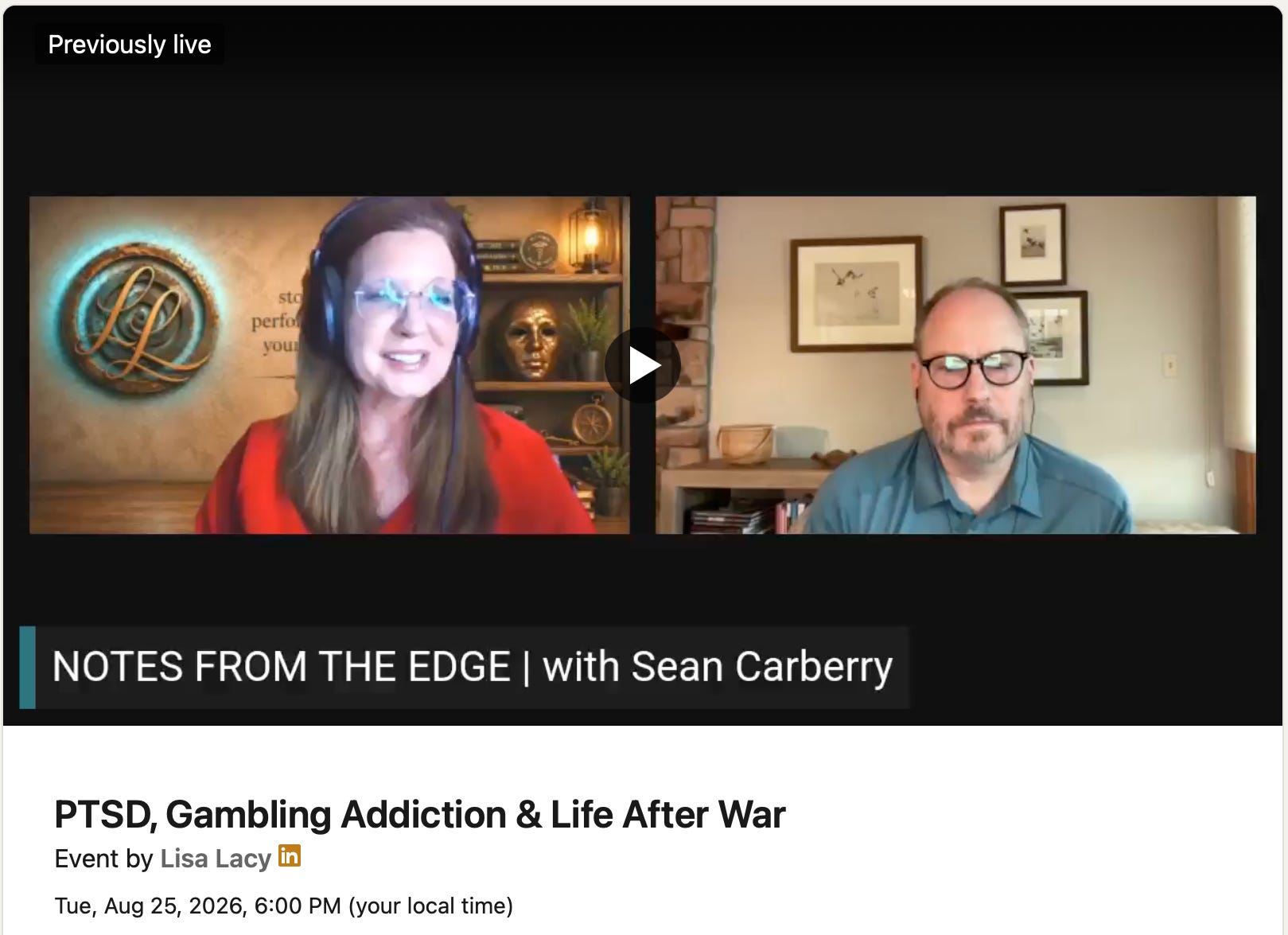
The second one was an even heavier conversation with Lisa Lacy for her Notes from the Edge podcast, which streamed live on LinkedIn and will drop on podcast services at 8pm on September 7. We discussed in detail the brain wiring that ties together war journalism, casino gambling, and a relationship with an abusive partner.
Lisa describes her podcast as “exploring trauma, recovery, identity, relationships, mental health, reinvention, and the roles people learn to perform in order to survive,” and we discussed all that and more. We also discussed what can be done to make mental health an integrated part of journalism, humanitarian work, and other civilian roles in war zones and dangerous places.
I hope you’ll give it a listen. I’ll be taping at least one more podcast this week. Stay tuned.
Lastly, a friendly request related to the scam discussion at the beginning of this post.
As I noted, I received pitches from people offering to boost my Amazon ratings. There’s an easy way to do that: get real people to leave real ratings and reviews.
So, once you’ve read Doubling Down, please take a moment and give it a quick review on Amazon or whichever platform you purchased the book from. If you’re on Goodreads, you can rate and review there too.
And please share this post or my other social media posts to help me reach a larger audience.
In the meantime, real agents are more than welcome to ping me.
Thank you so much for writing this story, Sean. It's really concerning what kind of scams AI is already facilitating and it's only going to get worse before it gets any better.