
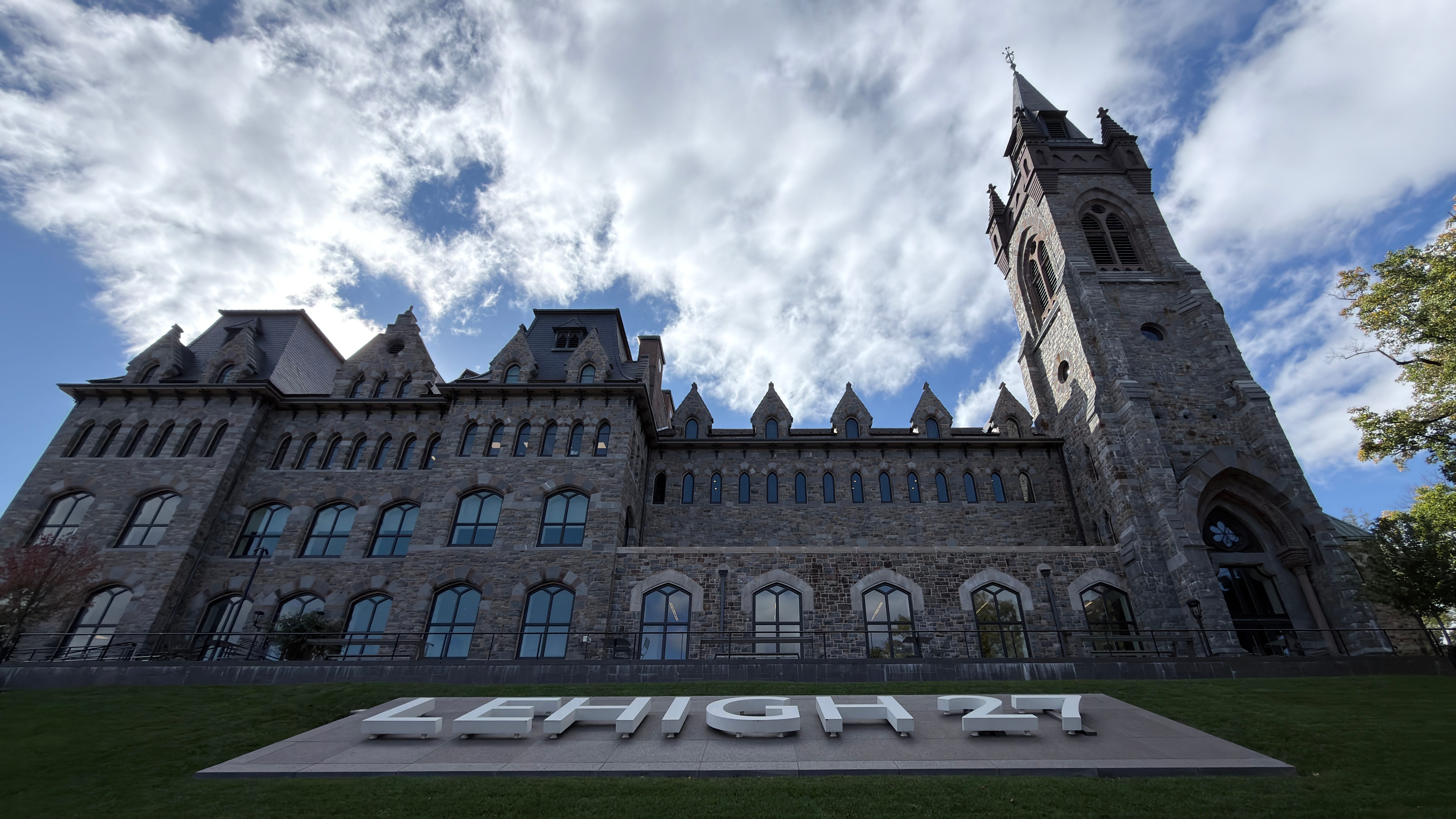
Fall at Lehigh University is a thing to behold. A gorgeous campus anytime of the year, it just sings in fall with the low-angled sunlight striking the gothic buildings and amber to crimson hues of the leaves on the towering maple, oak, and locust trees in just the right way. I loved autumn there as a student, and perhaps even more so in the years since when I have visited campus to speak to students.
Last month, I spent two days on campus guest lecturing to students taking journalism and media classes. One of the sessions I addressed was a Big Questions Seminar titled: “How Do We Tell Stories?”
For teaching purposes, I wanted to show how even the most mundane thing could be turned into a compelling story. I decided to tell a story about going to the dentist. I figured why not show how something we all do but never want to do or enjoy showing can be informative or entertaining?
It also happens that I have an interesting dentist story or two, in particular the time I had to seek dental care in the small city of Sheberghan, Afghanistan.
I quickly dashed out the anecdote. I wasn’t sweating the details or writing a piece of literature—initially—just mapping something out so I could tell the story in the class to set up my talking points.
Once I had the placeholder anecdote and outline of the discussion, I uploaded it all to Claude to have the AI app produce slides for the session. Claude threw me a curveball.
The app provided some critique of the story and suggestions of what I could do to improve it: tighten the intro to cut to the action faster, heighten the stakes a little to add some more tension and drama, give the Afghan dentist a little more character and color, strengthen the ending—which I knew when I drafted it was a little flat—to provide a better wrap up of the story, and consider whether to mention that NPR photographer David Gilkey, who was with me in the story, was killed a couple of years later in Afghanistan.
Claude was basically telling me that the story was fine for purely academic purposes, but there was a deeper, more meaningful story lurking if I wanted to dig down. It essentially called me out and said that I was holding back on the emotional content of the story, and what it really meant in my life.
I sat with the feedback for a moment. I had conceived the story as something fairly quick and quirky to make a teaching point about how you can find a story in something as trivial as going to the dentist, and I hadn’t envisioned polishing something to the point I would for the Moth Radio Hour or one of my books.
But Claude’s feedback nudged me enough to take another pass and really write the full story. By the time I finished, I had something far more powerful than I ever intended, and it landed completely differently. It moved from snark and comedy I started with to a deeper reflection and memory that I would actually want to share.
It also changed the lesson. Because Claude acted like an editor and gave me feedback on the story, I worked that into the talking points about the importance of editing, how sometimes you need that outside eye to see something staring you in the face, and how a couple of sentences can transform the entire meaning of a story. It’s also a lesson in how AI can be an incredibly powerful tool. The last paragraphs of this story would not exist had Claude not pushed me on two specific points: consider reworking an anticlimactic ending and think about whether the audience needs to know that one of the characters in the story was later killed.
A Visit to the Dentist, in Afghanistan
I threw a handful of mystery Afghan snack mix into my mouth. As I bit down on the nuts and strange rice balls, I felt a sickening cracking sensation. I was certain I had just fractured a tooth.
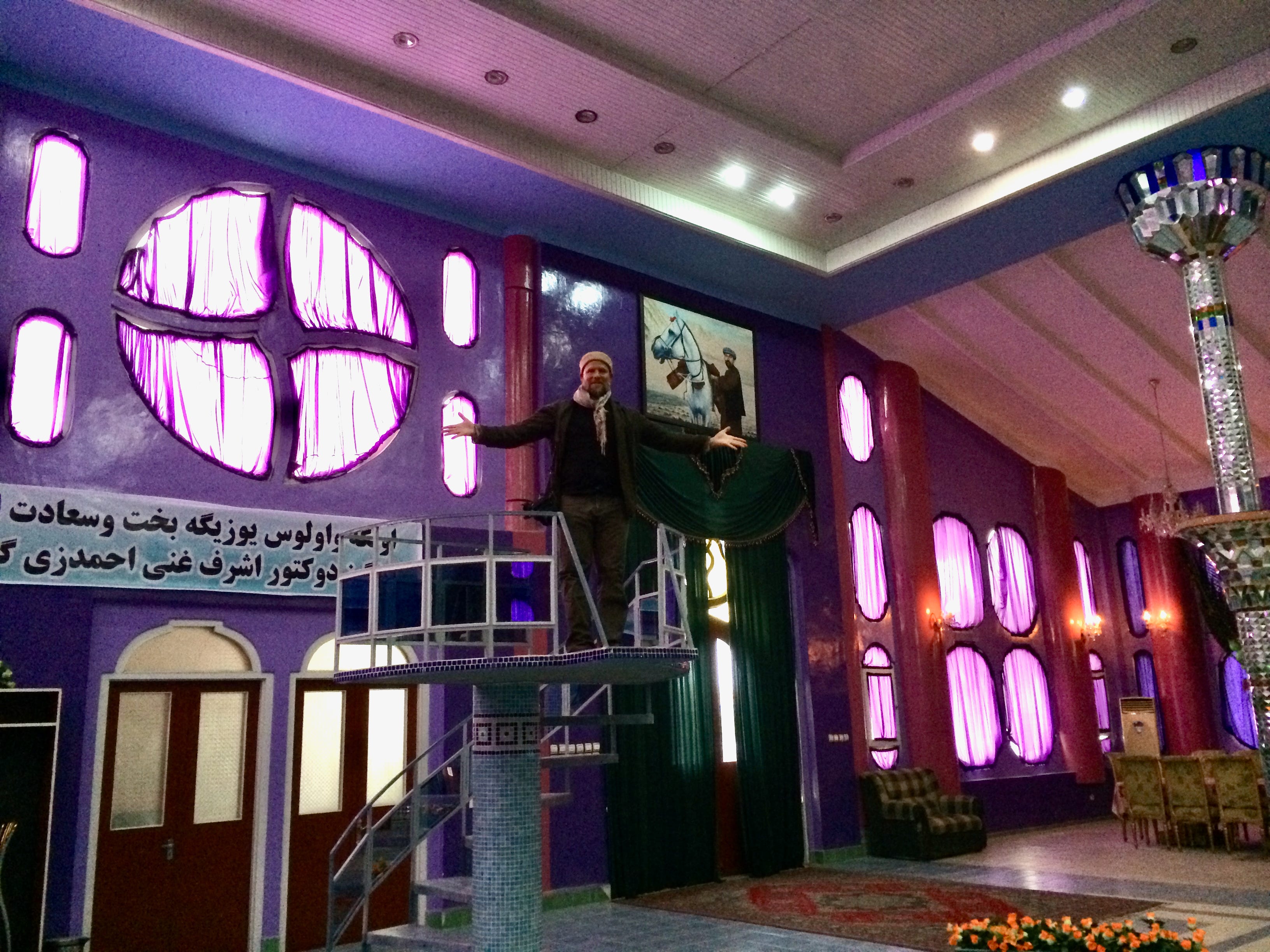
It was March 2014. I was NPR’s correspondent based in Kabul. NPR photographer David Gilkey, Afghan producer Sultan Faizy, and I were staying at the sprawling, tacky guest compound of notorious warlord Abdul Rashid Dostum. It was basically a 1970s Jersey Shore looking complex of rundown pink, salmon, and blue motel-like buildings around a black and white marble courtyard. Since it was Afghanistan, though, everything was covered with a fine layer of dust and grit.
One of the buildings was the entertainment house with an enormous swimming pool adorned with aqua blue mosaic and surrounded by 30-foot columns covered in mirror tiles. The reverberant room had an overall purple hue, and the translucent silk drapes over the windows filtered the edges of the light, creating the ambiance of an opium den.
We were guests of the warlord as we were in his stronghold of Sheberghan, the capital of northern Jowzjan province. We were there to report a feature story on the Afghan sport of buzkashi—and a side story on the warlord’s political ambitions as vice-presidential candidate in the country’s upcoming elections.
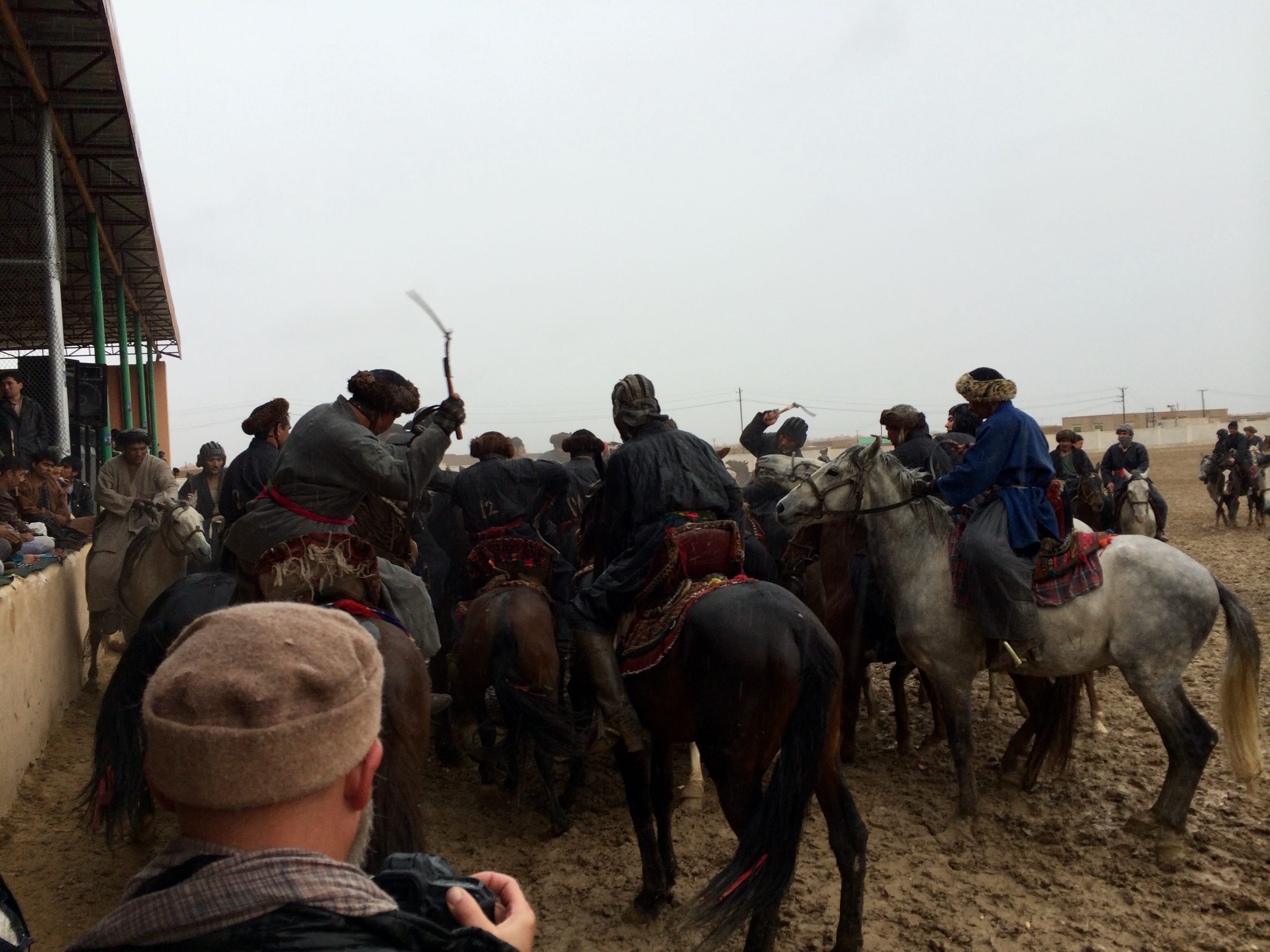
Buzkashi is a rather barbaric sport where men on horses try to pick up a headless calf, carry it across a playing pitch, and then drop it in a circle to score a point—all the while the other competitors are violently trying to rip the calf from whoever is carrying it.
The day we covered a match, it was chilly and rainy, turning the playing area to that kind of thick mud that grips your shoes and splatters mercilessly over your clothes and gear. The match began, and David and I moved around the pitch following closely the 30 or so competitors on their massive horses jostling and knocking into each other and trying to pick up the calf. Since David was shooting—mostly with his signature mix of short focal length lenses—he was wandering much closer to the scrum than I was as I recorded audio from a somewhat safer distance.
Still, we had to sprint out of the way now and then when a competitor broke free of the scrum with the calf and sprinted by. It was messy and dangerous, and we loved every minute of it. It was a bucket-list story for us.
That afternoon, we were in our drab, green room in the guest house. I had just finished filing a news spot for NPR, which involved me leaning into the closet with David and Sultan holding a blanket over me to improvise a sound booth—a frequent hack of radio field reporting.
As we were unwinding and contemplating dinner plans, we opened a can of snack mix we picked up in a local market. That was the handful I’d just bitten into. I spat out the food and cautiously felt inside my mouth.
The frontmost molar on my upper right side had split. There was a crack running diagonally up into the gum. One portion was still solidly anchored, but the other sliver was dangling. I could wiggle it, and it felt like it might fall out on its own. But it also felt anchored just enough in the gum that it might just stay in place if could avoid chewing on that side or avoiding the urge to wiggle it with my tongue in that way humans can’t resist inspecting any injury or abnormality in their mouths.
I was mildly panicked because I figured if I tried to pull the piece out it was going to hurt like hell and spurt blood like something from a Saturday Night Live skit.
We had a couple more days of work in Sheberghan, and getting to a trusted dentist meant a two-hour drive to an airport and a flight to Kabul. I was inclined to leave it alone, but I worried I might grind my teeth in my sleep or otherwise dislodge the piece and choke on it.
Sheberghan was a third-tier city in Afghanistan. It was not the kind of place you were going to find a University of Pennsylvania graduate dentist or a medical facility where you were confident you’d come out healthier than when you went in. Plus, it was a weekend, so there weren’t going to be any places open.
However, in Afghanistan, if you know someone, there’s always an angle. My producer was from Sheberghan and knew the elites in the city. He made a few calls and said that the best dentist in the city would meet us at his clinic in an hour.
Keep in mind, being the best dentist in Sheberghan, Afghanistan, is like being the best-looking guy at an Insane Clown Posse concert—it’s a low bar.
We drove through the packed-dirt streets past shuttered and dust-covered shops, dust-covered cars, and dust-covered people. We pulled up to a two-story building that was essentially a little strip mall. The ground level consisted of shops that were all closed, and the second level looked like offices. We climbed the rickety stairs and approached a door. Sultan knocked, and an Afghan man who appeared to be in his 50s—guessing age in Afghanistan is difficult as the sun, environment, and hardships prematurely age people there—opened the door.
Immediately inside was a small room with old, chipped furniture. On a table was a small gas stove and a steel bowl filled with dental instruments. They were soaking in some liquid with sediment floating on it. I paused.
The dentist was cordial and gestured welcomingly for us to come in. He didn’t speak a word of English, and I knew about five words of Dari.
I turned to Sultan and said there was no way in hell I was going to let someone stick any of those tools in my mouth. Sultan spoke with the dentist, who explained that he had proper sanitized tools in the treatment room.
We walked through a door into what looked like a professional dental office, from 1960. The chair and equipment were all spent, like they had been used in the United States or Europe for years and then donated to Afghanistan when they no longer met codes or specifications—that was common there. While the international community had provided a lot of new equipment and technology to Afghanistan since 9/11, a lot of what was there looked like hand-me-downs.
Still, the dentist had some tools that were in sealed packaging, so I felt it was worth seeing what he could do to triage the situation.
What I was hoping for, and asked through Sultan, was for him to apply some sort of dental epoxy to cement the dangling fragment to the base of the tooth so it wouldn’t fall out. It didn’t have to be pretty or particularly durable, just prevent it from falling apart in my sleep for a few days.
The dentist looked at the tooth and determined that pulling out the sliver would be painful and bloody, confirming my initial suspicions.
But instead of gluing it, he had another idea. He took a spool of dental wire—stuff used for braces I assume—and wrapped it around the tooth. His thinking was to essentially clamp it and hold the broken piece to the rest of the tooth with the wire.
As he started threading the wire around the tooth, I could see David and Sultan having the same reaction I was having—that it did not seem like a great solution. Except, whereas I was showing dismay, they were smiling and trying not to laugh at my predicament.
The dentist got a loop of wire around the tooth and then started twisting the ends of the wire to tighten it. It made awful squeaking sounds, and he yanked my head around as he twisted the wire with his pliers.
I started to panic. With each twist, the wire slid farther up my tooth to my gumline, and in sympathy, my testicles crept up into my abdomen.
Then, I realized he was going to at some point cut the ends off the wire, leaving the twist sticking out into my cheek and shredding it. My heart rate shot up.
I was trying to give the man the benefit of the doubt as a dentist and assume he knew what he was doing, but I was having a hard time seeing how it was going to end well.
I was clearly freaking out as he continued tightening. The wire was sliding up into my gum, causing me sharp pain and causing David and Sultan laugh out loud as I squirmed in the chair.
Just as I was about to ask the dentist to stop, he twisted one more time. The wire snapped. The sensation reverberated painfully through my head. The dentist pulled the wire out and looked like he was about to try again. I got out of the chair and said, “nope, we’re done here.”
I told Sultan to thank him and explain that while we were extremely grateful that he was willing to come in on a day off and help me in an emergency, we needed a different solution. The dentist was gracious, shook our hands, didn’t ask for payment, and we walked out.
I spent a few minutes swearing and ranting, asking why he couldn’t have simply glued the pieces together rather than his medieval approach of trying to bind the tooth like some sort of torturer. I was thinking like a Westerner who was used to dentists having state-of-the-art equipment.
Sultan reminded me we were not in the United States. As I reflected on that, I realized it was possible, perhaps likely, that the dentist simply didn’t have bonding materials and one of those Star Trek-like curing guns. Maybe that’s why he felt the wire solution was the next best thing—he was working with what he had available, which was why a lot of things in Afghanistan didn’t look like or work like the rest of the world.
We returned to the guest house, and I treated the tooth and my frayed nerves with some sort of bootleg or black-market vodka-like liquid that Sultan had procured in a local store. Sheberghan was one of the more liberal cities in the country, and it was actually possible for Afghans to buy sketchy bottles of alcohol from shops if you knew who to ask and what to ask for.
Fortunately, the tooth held together long enough for me to return to Kabul and have it properly serviced at the Indian-run clinic. The dentist numbed me up, removed the sliver, and did a partial root canal to stabilize the remaining tooth so my dentist in D.C. could crown it during my next trip home.
The buzkashi story David and I produced became a gorgeous multimedia piece, the fulfillment of an adventure we’d wanted to share for years. It was also one of the last stories we reported together. My assignment in Afghanistan ended later that year, and David was killed by the Taliban on a reporting trip he took to Helmand province in June 2016.
I think of him every day. One image that sticks with me is of him in that dentist’s office, watching with an expression of morbid fascination and trying, and failing, not to laugh at me.
Thanks as always for reading, and if you’re interested in doing some listening, the audiobook version of Doubling Down: A Memoir of War, PTSD, and the Dangerous Bets We Make dropped last month.
Also, I’ve been on a few podcasts recently talking about the challenges of coming home from warzone assignments and what news and other organizations owe the people they send on difficult assignments.
You can listen to Even Tacos Fall Apart, The MisFitNation, and the Man Space Podcast.
Until next time, Happy Thanksgiving, and as Warren Zevon once sang, take care of your teeth.