
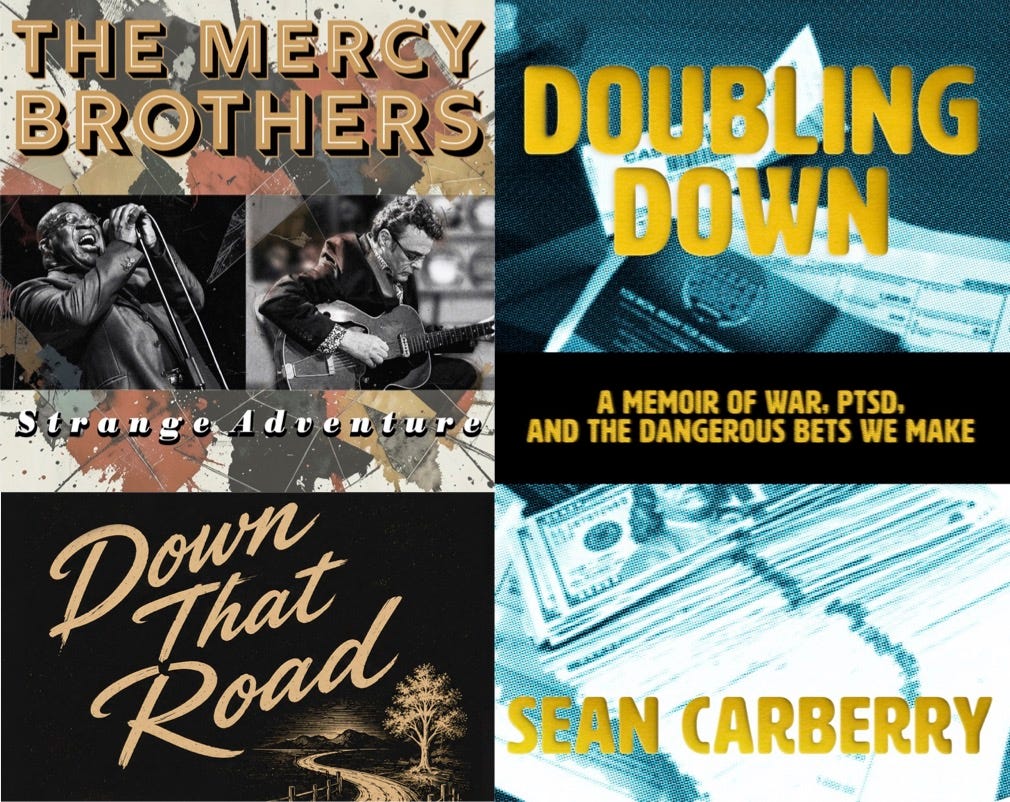
A couple of weeks ago, the last album I produced and engineered came back out for an encore. Twenty-three years after its initial release, Strange Adventure by the Mercy Brothers is onstage for another turn with some new packaging and liner notes.
It’s one of my favorite albums I worked on as a producer-engineer. In fact, I actually recorded it well after I had spun down and shelved my music career.
I had made a difficult but necessary decision in May and June of 2001 that I was closing the door on what to that point had been the defining chapter of my life: my music career. In 1994, I took a gamble and quit my mortgage banking job to crawl into a dark, musty-smelling recording studio in South Boston chase a dream of being a recording engineer and producer.
From the summer of 1994 through the spring of 2001, I slogged it out in studios in the Boston area, dreaming of becoming the next Glyn Johns or Brendan O’Brien—producer-engineers who made some of the greatest rock albums of all time.
In my case, I was unable to woo Boston rock bands away from Sean Slade and Paul Kolderie at Fort Apache or Mike Denneen at Q Division. Those studios and producers cranked out some major records in the 1990s by Boston and international bands alike:
Live Through This (Hole)
Pablo Honey (Radiohead)
Let Me Come Over (Buffalo Tom)
Only Everything (Juliana Hatfield)
The Burdens of Being Upright (Tracy Bonham)
Whatever (Aimee Mann)
Aurora Gory Alice (Letters to Cleo)
Those were the kinds of artists and albums I wanted to be recording. Instead, I was camped out at Room 9 and Rear Window studios working on a little of everything, but largely blues records. I had worked on a couple of blues records that did well—Susan Tedeschi’s Just Won’t Burn, in particular—and Rear Window had a sound that lent itself to old-school blues recordings, so for a few years I was “the blues guy” in the Boston area.
Thus, I worked on a slew of blues records, some better than others, but few were anything I wanted to listen to or use as a calling card. In 2000, I started teaching at Berklee College of music and freelancing at WBUR to hedge my bets a bit and maybe cure the blues.
Then, I had a project that did me in. A blues band I had worked with previously came back to me to do another album. I tried to push the band to step outside the 1959 sound we captured on the first album. I wanted to bring some Tom Waits or Los Lobos production qualities to the follow up—mainly to challenge myself and make things more interesting, but also because it was the right evolution from the first album.
They didn’t go for it. They wanted the exact same sound as the first record. We set up the “old-school sound” and started rolling. The early takes were a mess. The band was all over the place. It was the sound of eight-year-olds playing soccer—kids all chasing the ball and no teamwork.
I bailed. I gave the project to another engineer, quit the music business, and went full time at WBUR. A life-changing decision that led to me becoming a war correspondent, something I never would have conceived of at that time.
Two years later, Mike Dinallo, one of my favorite guitarists I had worked with—on a blues record, but a really good one—called and said he had a new project. I’ll let the bit I wrote for the reissue liner notes tell the rest of the story:
Strange Adventure is the Mercy Brothers’ musical journey through the hills and roadhouses of a bygone America. It’s also a fair description of my time as a recording engineer in Boston.
Michael Dinallo provided bookends of that journey.
We met in 1997, when I engineered the Radio Kings’ Money Road—the first complete album I recorded and mixed. Mike and I bonded as guitar players, rummaging through the arsenal of guitars and amps at Rear Window Recording Studio, chasing tones that would draw from and challenge the blues canon.
By 2001, though, I was weary of the blues treadmill: too many musicians more interested in rehashing the past than expanding it. Everyone wanted to pose at the crossroads, but few risked cutting a deal with the devil. I stepped away from the business.
Two years later, Mike coaxed me back. His new project with the irrepressible Barrence Whitfield was something else entirely: a collision of country blues, honky-tonk grit, and early rock. It was Americana stripped of the hipster-curated nostalgia that has dominated the genre.
The turning point came one night at Toad in Cambridge. Their rendition of “Down That Road,” pealed the paint off the walls. That was all it took for me skip out of my day job a little early one Friday and spend two weekends helping Mike realize his vision for Strange Adventure.
Rear Window had state-of-the-art gear, but we weren’t after polish. We wanted the grit and swagger of a small joint in Memphis, New Orleans, or Oslo, where the walls sweat along with the band. We went as wide-open and live as possible.
On Strange Adventure, Mike’s acoustic guitar set the anchor, drawing on country blues, folk, and roots traditions. Andy Plaisted’s drums and Paul Kochanski’s bass locked into organic, rolling grooves, giving Barrence’s vocals room to swoop from croon to wail. Vidar Busk’s guitar was pure high wire act—equal parts Scotty Moore, Duane Eddy, and Jimi Hendrix. Add in the two Tims on harmonica and dobro, and you had all the ingredients for an epic musical odyssey that would have had Alan Lomax reaching for his Ampex.
The journey begins with a rolling, haunted take on “Another Man Done Gone” and closes with the menacing “Mr. Johnson,” evoking Peckinpah’s west. In between, the band barrels through “Night Train to Memphis,” rattles a “Broke Down Engine,” makes you want the “New Year’s Blues,” and coaxes you aboard a rollicking “Misery Train.”
“Down that Road” was a live take by Mike, Barrence, and Andy. Mike and I then went full Andy Johns and Jimmy Page, layering on guitar parts until we achieved the glorious onslaught you hear on the album.
I return to Strange Adventure several times a year. For me, it’s a testament to Mike’s encyclopedic command of American music, Barrence’s dynamic range, and the joyful noise a small crew can make when they tap into something larger than themselves. For a few days in 2003, we captured lightning. It still crackles.
And so, what was a coda to my music chapter is in its second act at the same time a coda of sorts to my memoir, Passport Stamps: Searching the World for a War to Call Home, is about to hit virtual shelves as well.
If you read Passport Stamps, you might recall that the final chapter and epilogue talked about my struggles after returning to D.C. from my time in Afghanistan. I briefly mentioned gambling, an abusive marriage, and other struggles of trying to find purpose and a “home” again after leaving a bizarre world where I felt I belonged.
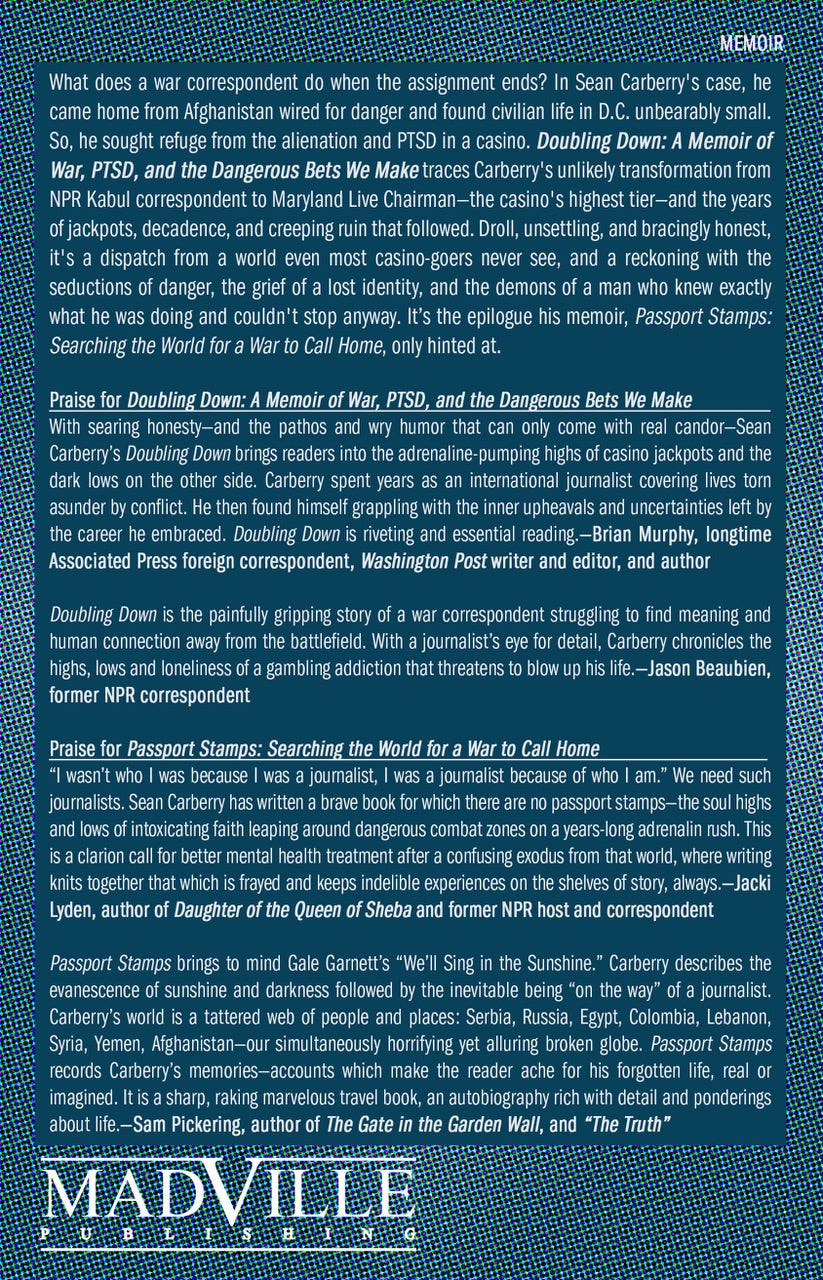
Doubling Down: A Memoir of War, PTSD, and the Dangerous Bets We Make is the full story of the years I spent chasing it in casinos and grieving my loss of self. It’s a shorter work than Passport Stamps, and coming out initially August 15 only as an e-book, but it’s an important read.
While it’s my specific journey, it’s a window into something we need to be discussing as a society. What do we owe everyone who has been asked—or volunteered—to serve in some capacity in the post-9/11 conflicts and other “adventures”? When someone is asked to risk their life to fight, cover a story, provide humanitarian assistance, or redevelop a shattered nation, what recognition and support should they get when they come home? How do we help them process what they experienced and reintegrate into what for many is a world that no longer makes sense?
In my case, I came home a different version of myself—one I didn’t recognize or understand. My brain was altered by years of taking risks, pushing my bets, and playing dangerous hands as I ran around war zones and hostile environments reporting on the horrors humans inflict on each other. So, it was almost preordained that when I got home, I would find my way to a casino to provide my brain the danger and chaos it was craving.
Doubling Down is the cautionary tale about what happened next, coming soon to an e-reader near you.