
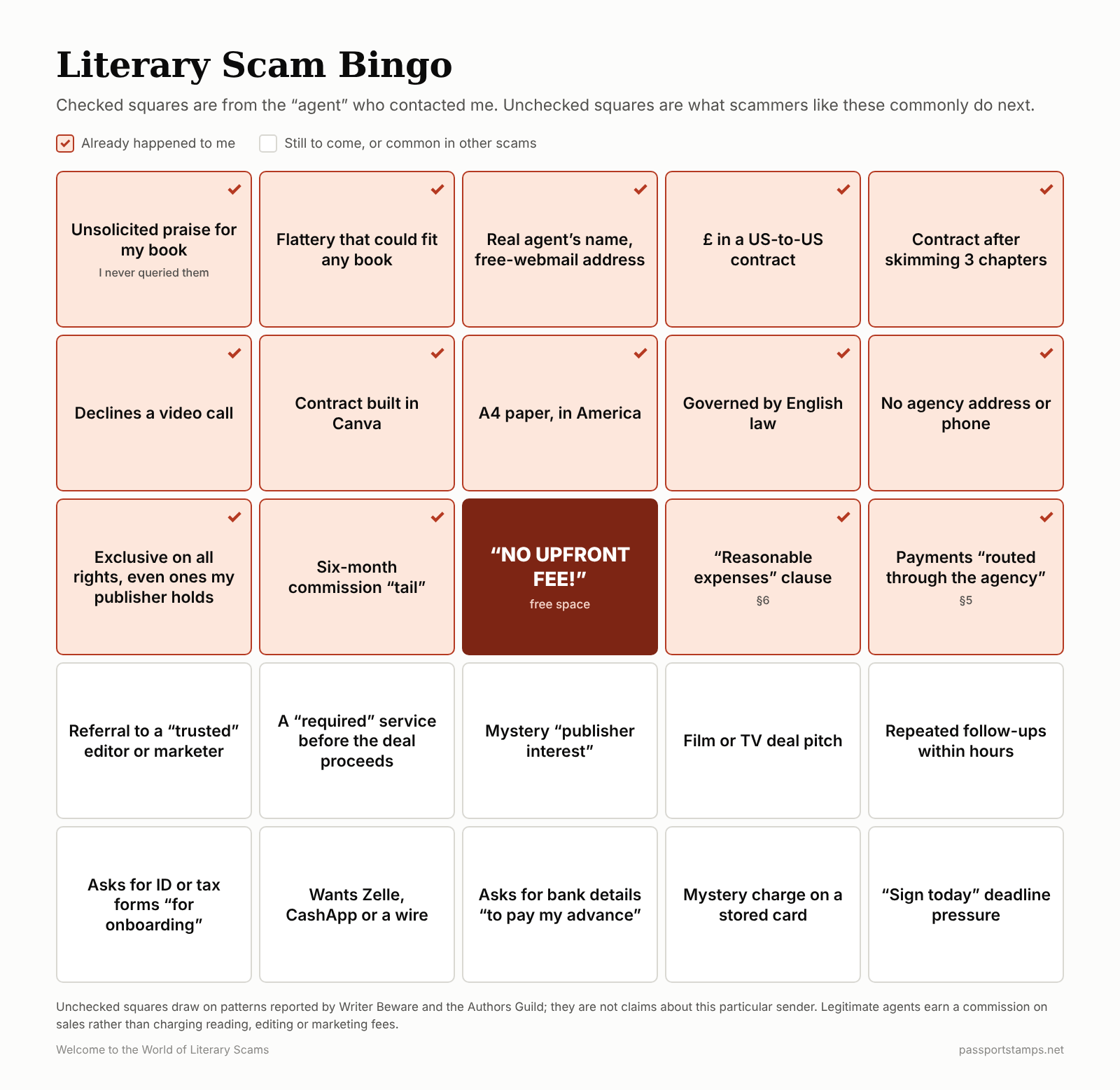
If you wrote a book, how desperate would you be to get it published? What lengths would you go to, and how much would you pay or invest in getting your thoughts and words into print?
Scammers these days are betting that a fair number of writers are willing to hand over significant sums of money in hopes of landing a deal with a top tier publisher. Apparently, a fair number of writers are doing just that.
In my last post, I discussed how I recently learned about the niche world of literary scams, where criminals pose as book agents or editors. They apparently scrape the internet for signs of budding authors or independent authors who might be hoping to sell a book. They send unsolicited, flattering emails about how they “came across your book” and how fascinating it seems. They strike up a conversation to lure you down a rabbit hole toward a “deal,” and at some point, once you’re hooked, they start sucking money out of you.
As I wrote last month, I received such an email after Doubling Down dropped:
Dear Sean,
I recently came across Doubling Down and was struck by the unusual journey at its center—from war correspondent in Afghanistan to the highest tier of a casino, and the complicated relationship with danger that connects those worlds.
The way the memoir explores identity after war, the difficulty of returning to civilian life, and the search for something that can replace the intensity of conflict feels particularly compelling. I was also interested in how it expands on the story introduced in Passport Stamps.
I’d love to learn more about what prompted you to revisit this chapter of your life and what you hope readers take away from it.
Are the publishing rights currently available in any territories or formats, or are you represented by a literary agent?
Despite a moment of giddiness—a few seconds at most—I quickly came back down to earth and realized it was a scam. Afterall, most literary agents I pitched my first book to never replied, so I know that no senior executive is going to be proactively reaching out to unknown authors, especially through a non-public email address—although one that could be guessed or constructed through trial and error.
I am curious how many other Sean Carberrys received the same email from the bot or scammer that tried every conceivable gmail, Hotmail, and yahoo address you could come up with based on “Sean Carberry.”
Anyhow, I decided to play along to see where it would lead and what the con would be in the end. My last post left off at the point when the scammer had recommended a literary agent I contact to discuss a print deal for my current e-book and a TV agent I should contact to discuss my TV show concept based on my books.
Several weeks after receiving that email, I returned to the game and contacted both “agents.” The TV agent never responded, but I’ve had an ongoing exchange with the “literary agent.”
I wrote:
Hi Emily,
I’m reaching out at the recommendation of Suzanne at [Redacted]. She contacted me about my new e-book Doubling Down: A Memoir of War, PTSD, and the Dangerous Bets We Make.
She had inquired about my deal with Madville for this book and my previous memoir, Passport Stamps: Searching the World for a War to Call Home.
Both are licensed to Madville for e-book and audio book foreign and domestic, and Passport Stamps is licensed for print rights as well. I retain print rights for Doubling Down.
Suzanne thought you might have some ideas about what could be possible with the rights I retain, but also possibly having Madville sell my rights, which is something they have done before. Madville often publishes books that catch on and end up with larger publishers. They would be happy to explore options.
Here is my site with info on the two books: www.doublingdown.net
Eager to hear your thoughts about what might be possible. I think the subject matter of Doubling Down is timely and important and could resonate with a large audience of veterans and civilians and those interested in where society and culture are heading with the proliferation of gaming and gambling sites.
Cheers,
Sean
Later that day, I received the following:
Dear Sean,
Thank you for reaching out, and please thank Suzanne for directing you to me.
I have taken a particular interest in the description of Doubling Down. The combination of your experience as a war correspondent, the transition back to civilian life, PTSD, identity, risk, and your experience within the casino world gives the book a compelling narrative and a number of meaningful avenues for positioning.
Given the interest Suzanne has already shown in the project, I would like to give this a very careful review rather than make an initial assessment based only on the website and description. I was also unable to access the website properly from my side, so I would prefer to review the material directly.
While I go through the manuscript, could you please send me:
The first three chapters of Doubling Down, so I can assess how the story opens and how the narrative develops from the beginning.
Your current query letter, if you have one.
The synopsis you are currently using for the book.
I would also appreciate it if you could confirm whether the manuscript is currently complete and whether the version you send reflects the latest revision.
I understand the rights situation you outlined. Since Madville currently holds e-book and audio rights, while you retain print rights to Doubling Down, I would also like to understand the rights position fully before discussing what options may be available.
My immediate priority, however, is the manuscript itself. I want to understand the work on its own merits and see where it may fit before we determine the most appropriate path forward.
Once I have reviewed the opening chapters and supporting materials, I can come back to you with my initial thoughts and the appropriate next step.
I look forward to reading it.
Warm regards,
Emily [Redacted]
Literary Agent
This was a quick escalation, and clearly unrealistic as an agent would never immediately jump at a cold call email so quickly, especially one that did not come in through their prescribed contact mechanism and protocols. Agents have rules, like typically you have to submit a query letter and proposal through an online portal. Even then, they rarely reply, let alone the same day.
One quick note, the line about not being able to access the website properly is a classic AI tell. I often receive a message like that from AI bots when I ask questions about content on some web pages that have protection measures to prevent bots from downloading or stealing content.
Anyhow, the conundrum this response created was that I needed to send something back to keep the ruse going, but I obviously wasn’t going to hand over the real first three chapters of my book to a scammer. I decided to have some fun with it.
I turned to Claude AI, and I explained what was going on—that I had been contacted by a scammer, and I was playing along to see if I could “catch” the scammer or at least gather more intel to help raise awareness and prevent others from being scammed. Claude was eager to play along.
I told Claude I needed three fake chapters. Here’s the prompt:
Since I know the scammer isn’t going to read the work and will respond saying it’s great and we should work on a contract, the actual substance of what I send is irrelevant. Thus, I’d like you to write three fake chapters that don’t have any actual details or facts from Doubling Down. In fact, I want the content to be clearly ridiculous and fake. So, I’m thinking using things like 1984, Dilbert, Doonesbury, 30 Rock, James Bond, Whiskey Tango Foxtrot, and a little bit of Homeland mixed together to create the chapters. The main character is Roland Zevon, correspondent for the Wide World of News, and spent 4 years covering the war in Eastasia. He returns after Oceania wins the war and is living in Montenegro and visits the Casino Royale. He gets addicted to the new game of Casino Dominoes. He becomes a high roller and spends weekends in the casino drinking Vespers, being comped exotic meals and show tickets. He falls for a fellow gambler named Xenia, who turns out to be an assassin with a ketamine addiction. Using those elements, construct three chapters of a fictitious version of Doubling Down using similar writing style as the author and following similar narrative arc. Keep the chapters short, 2-2500 words—enough to seem plausible as real chapters, even though we are certain that the scammer won’t actually read them. That’s the point, to create something so ridiculous and clearly not Doubling Down that the story I’m writing about this scam will be even funnier when I get a response from the scammer talking about how well written the chapters are and how realistic it is.
Claude responded with three chapters of legitimate genius. In fact, it’s a really entertaining read, probably much more so than my book, but that’s another discussion for another time. Here’s a taste of what Claude wrote:
Chapter One: The Jaws of Doublethink
I was down more than 11,000 Minitrue Credits, which at the Casino Royale’s official exchange rate was either a devastating loss or a modest gain, depending on which day’s recalculated conversion bulletin you chose to believe. I had chosen to believe the one from Tuesday, because it was the only one that let me order another Vesper without feeling the particular shame that comes from doing math in a casino.
I had been glued to the Dominoes table in the high-limit salon for the better part of eleven hours. Time moves strangely in Montenegro in general, and in the Casino Royale specifically, where the clocks are set fourteen minutes fast “for efficiency,” a practice nobody has ever explained and everybody has stopped asking about.
Casino Dominoes is not dominoes. I want to be clear about that up front, the way I wish someone had been clear with me. It is played with forty-one tiles, three of which do not exist but can still be bet on, a rule explained to me by a pit boss named Gregor who has one gold tooth and an expression that suggests he has seen men lose their apartments and found it only moderately interesting. The game rewards patience, arithmetic, and a willingness to accept that the House has already won before you sat down. I found this oddly similar to four years of filing dispatches from Eastasia, where the House also always won and the arithmetic was classified.
I submitted my fake chapters to “Emily.” I received a response quickly:
Hi Sean,
Thank you. I’ve received the materials, including the query letter and the first three chapters in their final edited form.
I’ll review everything carefully with my team and get back to you on Monday with our initial thoughts and the appropriate next steps.
In the meantime, could you let me know what level of professional editing the manuscript has gone through so far? Specifically, whether it has received developmental editing, line/copy editing, and proofreading, and when the most recent editorial pass was completed.
That will help me understand the manuscript’s current stage as we review it.
I responded and said the work had been through multiple rounds of developmental and copy editing and final proofing. Again, “Emily” responded quickly with another question.
Thank you for clarifying. That gives me a clear picture of the manuscript’s editorial stage.
One other point I’d like to confirm as part of my review: have you previously been represented by a literary agent for this manuscript or for any of your other books? If so, could you let me know who represented you and whether that relationship is still active?
This will help me understand the representation history before I complete my review.
All her questions seemed reasonable and legitimate—stuff that would make sense to an unsuspecting author and string them along. I responded and told her I have not been represented by an agent—the sad truth as I failed to persuade some 70 different agents to take on Passport Stamps and didn’t even bother with Doubling Down.
“Emily” responded with another message to string things along.
Hi Sean,
Thank you for confirming. That is helpful to know.
As I complete my final review of Doubling Down, I also want to clarify how the representation process would work should I determine that the manuscript is a strong fit for my list and that I am prepared to represent the project.
At that stage, I would provide you with a literary representation agreement outlining the terms of our professional relationship, including the scope of representation and how we would work together on the book and its rights. I would want you to have the opportunity to read and consider the agreement carefully before making any commitment.
For now, there is nothing you need to sign. I want to complete my manuscript review first and make sure I have a clear understanding of the work before we discuss representation formally.
I’ll continue with the review and will be in touch with my assessment and next steps.
Best regards,
Emily
She dangled the prospect of an agreement, assured me there was nothing to sign for now, and reassured me she was reviewing my material. This played out over several days, a plausible timeline to make me think she was digesting my submission.
Then came the big response:
Hi Sean,
Thank you for giving me the opportunity to review the opening chapters of Doubling Down. I’ve now gone through the material carefully, and I can see why Suzanne felt the project had potential.
My initial assessment is very positive. The manuscript is in a substantially stronger position than a typical early submission. The writing is polished, the voice is distinctive, and the opening immediately establishes a compelling narrative engine. The combination of war correspondence, the difficulty of returning to civilian life, PTSD, gambling, identity, and the psychology of risk gives the memoir a strong central theme. The casino setting also provides an effective framework for exploring what happened to the narrator psychologically after the war.
A few things particularly stood out to me:
The voice is confident and distinctive. The dry humour and intelligence give the narrator a clear personality without making the subject matter feel trivial.
The opening has a strong hook. Beginning in the casino and then gradually revealing the connection between the gambling environment and the narrator’s experience of war works well.
There is a clear thematic thread. The idea of uncertainty, institutional messaging, risk, control, and the need to find meaning carries through the three chapters.
The prose is already professionally developed. I am not seeing the kind of fundamental writing issues that would make me recommend another major rewrite before considering the project.
There is a strong commercial narrative underneath the memoir. The book is not simply about gambling or PTSD. It is about what happens when someone loses the environment that gave their life structure and then finds another environment that reproduces the same psychological patterns.
There are, however, a few areas I want to examine against the complete manuscript before making a final representation decision. In particular, I want to make sure the balance between humour, war experience, PTSD, gambling, and the more dramatic elements remains effective throughout the book. I also want to see how the narrative develops beyond the opening and whether the later chapters deliver the same level of momentum and emotional depth.
One point I would also like to clarify with you: the manuscript uses names and terminology such as “Eastasia,” “Oceania,” “Minitrue,” and other deliberately altered references. Before we proceed further, I would like to understand whether these are intentional pseudonyms/creative substitutions throughout the memoir or whether the manuscript is using a fictionalized framework to represent real events. That distinction will be important when considering the book editorially and for submission.
Overall, I believe the manuscript is at a serious professional stage and is worth taking forward to a full evaluation. I don’t think you need to undertake another broad editing process simply based on these opening chapters. The previous developmental and line-editing work appears to have produced a polished opening.
My next step would be to complete the review of the material and then determine whether I am prepared to move from manuscript evaluation into a formal representation discussion. If I decide to represent the project, I would provide you with a literary representation agreement for your consideration before anything is formally undertaken.
For now, please let me know about the intentional use of the altered names and terminology above. That clarification will help me complete my assessment properly.
Best regards,
Emily
Once again, effusive praise to butter me up. What surprised me was the level of apparent detail of “reading” of the fake chapters. While I knew that had I turned in 20 pages of “all work and no play makes Jack a dull boy,” I would have received similar praise since the goal is to get me to sign some sort of contract and pay money for representation costs of one kind or another, but I was a little surprised at the level of detail in pulling out threads from my work. AI, it’s all in the AI, whether it’s used for good or evil.
However, the request for the full manuscript and questions about the deliberately altered references gave me pause about how to move forward.
I ran the response by Claude, and it suggested giving a bland answer on the names and to try asking for a sample agreement just so I have a sense of what things might look like before I hand over the rest of the manuscript—which I had Claude write just in case “Emily” dug in and demanded it before sending a contract.
I sent this response:
Hi Emily,
Thanks for the careful read, and I’m glad the opening worked for you.
Yes, the altered names are intentional. The book uses a fictionalized naming framework throughout, but the events themselves are real. I changed the names of countries, institutions, and individuals for legal reasons and to protect sources, so “Eastasia,” “Oceania,” and “Minitrue” are composites. I know some of the later material, particularly the Xenia chapters, reads as stranger than fiction, but I can assure you it’s all true.
If you’d like to see the full manuscript, I’m happy to send it once I better understand the next step. Could you provide more information on how you see things playing out should you be satisfied with the rest of the material? What would a representation agreement look like regarding terms, percentages, fees, etc.? Can you send an outline or overview?
Cheers,
Sean
That was enough. I quickly received the following:
Dear Sean,
Thank you again for your response and for clarifying the use of the fictionalized names and terminology. That is helpful as I continue with the evaluation of Doubling Down.
I have attached the Literary Agency Representation Agreement for your review. Please take some time to go through the terms carefully, particularly the provisions concerning representation, commission, rights, term, termination, and expenses.
If everything is clear and you are comfortable with the terms, please sign the agreement and return the signed copy to me by email.
If there is anything in the agreement you would like me to clarify before signing, please feel free to let me know.
I look forward to receiving the signed copy and proceeding with the next stage.
Warm regards,
Emily
Attached was in fact a very standard looking contract for a UK-based literary agent. And as if to ease any concerns that it might be a scam, there was this clause in the contract:
The Author shall not be charged an upfront representation fee, submission fee, reading fee, or monthly agency fee for ordinary literary representation under this Agreement.
The Agent’s primary compensation shall be commission earned from transactions resulting from the representation.
I read through the agreement looking for the con, and there was nothing overt. But there was this section:
6. EXPENSE REIMBURSEMENT
The Agent shall not charge the Author for ordinary agency overhead or routine representation activities, including ordinary email correspondence, telephone communication, standard submissions, and routine administrative work.
The Author shall reimburse the Agent only for reasonable and necessary out-of-pocket expenses specifically incurred on the Author’s behalf.
No individual expense exceeding £50 shall be incurred without the Author’s prior written approval.
Any significant or unusual expense shall be discussed with the Author before being incurred whenever reasonably practicable.
So, here’s where the con finally entered the room. This clause gives the “agent” the chance to play the author. Maybe it starts with requiring a few hundred dollars to complete some sort of legal or copyright filing. Then another few hundred for producing a flashy brochure and pitch materials. Then maybe the manuscript needs one final edit for $2,500, and then maybe some initial cover and layout design for another $2,500. Perhaps there’s another $4,000 for the agent to attend a literary fair with publishers.
A naïve and eager author could potentially shell out tens of thousands of dollars in seemingly plausible expenses to secure a book deal.
It has happened.
Victoria Strauss writes about such scams for the Writer Beware website. She says she’s heard of authors shelling out hundreds of thousands to scammers.
While I’m sure it’s true, I find it hard to believe that someone would that desperate—and solvent—to be willing to drop that kind of money chasing a book deal.
When I was pitching Passport Stamps, I reached out to a hybrid publisher—a supposedly legitimate publisher that does traditional deals and variations of self-publishing deals where the author fronts the expenses, and then the publisher releases the book.
That publisher looked at my draft and then sent me a proposal to do multiple rounds of editing, design, layout, proofing, and all the other required services to complete and release my book. All they wanted for all that was about $70,000. I laughed and moved on.
Apparently, though, some authors are willing to spend that kind of money and hand it over to “agents” who email out of the blue and seem too good to be true.
In my case, I knew from the beginning that I was being conned and have decided to play it out to see what I could learn from the gambit. After I received the contract, I decided to put the “agent” on the spot.
Hi Emily,
Thanks for sending the agreement. I have reviewed it, and most of it seems reasonable. I do have one concern, though. I am based in the United States and therefore would prefer to sign with a U.S.-based agent and a contract governed by U.S. law.
I’d be happy to set up a call so you can explain the distinctions of a contract under English law to see if it would be acceptable. Otherwise, I’ll continue exploring options with U.S. agents.
Thanks,
Sean
I have not received a response. Has my agent given up on me already? Did the AI not anticipate such a response? I find that hard to imagine. I expected some sort of attempt to reassure me that UK law is more protective of authors, and no call is needed at this time for some reason or another.
In the meantime, I had a conversation last week with the Man Space Podcast about my journey into war journalism that ended with me wandering into a high-limit room in a casino for years chasing the same adrenaline rushes and seeking some place of belonging. We covered a lot of ground about how people coming home from war struggle to reacclimate and casinos are ready to prey on brains that can’t make sense of “normal life.”
You can listen to the audio version here or watch on YouTube here.
Keep your head on a swivel, and watch out for scams. They are everywhere.